Thoughts on Züm II
This morning myself and @mfac19 were the third and fourth passengers on the first ever Züm departure from Brampton Terminal to York University at 4:45am. There was much fanfare and we all got swag. I am now near Islington heading back home, and here are a few thoughts:
Read more »Labels: brampton transit, bus rapid transit, service changes
Thoughts on Züm
On September 20th, Brampton Transit will launch Züm, a limited stop bus service running every 15 minutes between Downtown Brampton and York University (and twice as frequently during the peak hours). In the process, service on Highway 7 in Vaughan and Queen Street in Brampton will be completely reorganized.
Read more »Labels: brampton transit, bus rapid transit
Visions for the GTTA: Rapid Transit, Part II
This post is a continuation of
this post.
Recommendation #3 - Quickly introduce Rocket service to major corridors
Within recent memory, several bus-based rapid transit projects have been implemented to improve transit service in the GTHA. Notables among them include iXpress, which snakes through Waterloo Region; A-Line and B-Line, forming a north-south network in Hamilton; and VIVA, York Region Transit's celebrated rapid transit network. In the fall of 2010, Zum in Brampton will come online and provide express service along the Queen Street corridor. While there is no question that these routes have been successful, they all run primarily in mixed traffic and they all experienced long implementation times. Zum, for example, can be traced back to 2004 - a six year lead time for only 1/3rd of the first phase.
[More after the jump...]
Read more »Labels: bus rapid transit, GTTA plan, light rail, streetcars
Visions for the GTTA: Rapid Transit, Part I
When it comes to rapid transit, one thing is clear: Torontonians want subways. If anything less than a subway is constructed then the system is somehow inadequate - too slow and too crowded. But, a transportation planner once told me that congestion can be defined as the result of a justified rationing of a scarce resource. Many years ago, society decided that our forests were a scarce resource and that it was not acceptable to cut down all the trees in the world to make paper. As a result, we began rationing new trees and encouraging the use of recycled materials. The transportation network is similar. Capacity is a limited resource, and constructing enough capacity to match all demand may placing our society in an unwanted position.
Imagine if we added enough capacity to Highway 401 through Toronto to ensure that every car could travel at the speed limit at all times of the day. In order to provide this level of capacity the highway would have to be at least 50 lanes wide. To accomplish this, we would have to bulldoze the communities adjacent to the highway and displace all of the residents and businesses. This would cost billions of dollars that could not be spent on other things that could benefit our society. Such a highway would be grossly underused at all times other than the peak hour and leave us with wasted capacity. In short, constructing enough capacity to provide the highest quality of service imaginable is not a good idea. I am not saying that we should never build another subway line in the GTHA, as some that feel light rail advocates believe. What I am saying is that the transit technology choice is a complex decision and needs to involve demand, expected development, and cost. Not every line can or should get a subway, but here is where I think we should upgrade our transit facilities to deliver a higher quality transit service.
[More after the jump...]
Read more »Labels: bus rapid transit, GTTA plan, subways
Mississauga Transitway: hopefully not a boondoggle in the making
A friend and I went to the Mississauga Transit BRT project open house tonight, taking one of the first 12-coach GO transit runs ever pulled by a single locomotive. We had a chat afterwards, and I think I speak for both of us when I say this:
The City of Mississauga has managed to take an idea which had some good points, crippled it, and finally, just for good measure, ensured it will only serve one type of customer making one type of trip.
Before the criticism, I will offer some background information. The BRT project is to build a transitway (bus only road - I use the term Mississauga BRT and Mississauga Transitway interchangeably) between Winston Churchill Blvd and Renforth Drive along the Highway 403/Eastgate Parkway/Eglinton Avenue corridor. At the Renforth Gateway station, buses could travel north to the airport, south to the subway, or east towards Toronto. GO will also be using the busway to get its vehicles out of the 403 traffic. Major destinations include Square One and the Airport Corporate Centre.
After listening to a presentation on the project in general, we broke into small focus groups. This is where things began to unravel.
It doesn't look like they will be using special buses, because they want neighbourhood buses to use the transitway to get to Square One. As a result, it seems that they don't see the need for premium vehicles with this type of operation. This is a letdown, as I doubt VIVA would have been as successful if it used ordinary YRT buses.
It doesn't look like they are even talking to the TTC, because when my friend asked about integration to the Eglinton-Crosstown line, he kept talking about Presto. I pressed the gentleman, and couldn't get a straight answer from him. All we wanted to know was if it would be a cross-platform transfer or something more complex.
Another women expressed the same concerns, wanting to know if schedule integration with TTC services was being explored. She didn't want to get to Renforth and have to wait 35 minutes to go further. Her answer was just a reiteration of the fact that the BRT services will operate every 7 minutes.
These are just two examples, but I think it shows that the "Mississauga In a Bubble" sentiment has taken hold of city hall.
Many people would argue that Transit City is not an effective transit plan. What you must remember is that Transit City is not only designed to move people - it is also designed to encourage the type of development that the official plan calls for (which is mid-rise, evenly spaced across the street - not extreme high density nodes with nothing in between). If you evaluate Transit City by its intentions, then you begin to see why it was proposed the way it was proposed.
Similarly, you can evaluate the Transitway by its intentions. It is intended to move people from the west end of Mississauga and Square One to the Airport Corporate Centre and to the TTC with 35 minutes end-to-end running time. It will be great for getting people to the subway, but unless the ambiguity around the Renforth Gateway isn't solved, it will be an epic fail in getting people to all the TTC services it touches.
But, all is not lost. They haven't entered into the detailed design phase, so there's still time to correct the flaws. They are doing a great job, but I fear that the toolbox they are using doesn't have all the tools they'll need.
...And Mavis needs a stop. I don't see the rationale for eliminating it.
Labels: bus rapid transit, mississauga transit
OC Transpo: a capital experience
I believe every Canadian should spend at least one Canada Day in Ottawa. This past weekend, I accomplished it along side my closest friends, who truly made the trip memorable.
My day began on Saturday morning at 6:00 AM at the Metro Toronto Coach Terminal. The 6:45 Greyhound departure was oversold, but we managed to get onto an advanced departure. A Voyageur (partially owned by Paul Martin, under contract to Greyhound) MCI D4500 was our coach, and departed closer to 6:30. Our route was the 401 to Belleville, highway 37 through Tweed to Highway 7. Our rest stop was at a small place named The Log Cabin Restaurant in a community named Actinolite (named after the mineral mined nearby, which you might know by its less P.R. friendly name, Asbestos).

Our coach is in the near right, with the second section behind us and a Toronto bound coach on the left. Being a Greyhound agency, this restaurant was able to handle the snack, drink and washroom needs of the coordinated arrival of 165 passengers within 20 minutes. Soon, we were back on our way east on Highway 7, through Perth and Carlton Place before signs of Ottawa's rural annexations came into view. The final leg of the trip along the 417 was smooth, and we pulled into the Ottawa Bus Central station early. Liz, our host for the weekend, picked us up and shuttled us to her apartment in what I can best describe as midtown Ottawa, just across the street from the Transitway station.

More on the Transitway later, but it being Ottawa's rapid transit system, an apartment that close would be coveted and expensive if in Toronto. The first stop on the day was the ByWard Market, an open air market and tourist destination. The Chateau Laurier was next, followed by the Parliament building, where due to Liz and her boyfriend Ben's connections to the government, we got a VIP tour. I had been to Parliament years ago, but never when velvet ropes and pedestrian barriers did not apply to me. At one point, security guards chased us down for entering off-limits areas, only to excuse themselves upon seeing our credentials. As we left, we heard Grégory Charles and Eva Avila rehearsing for the concert the next day - leading to inside jokes that continue to this day. The rest of the day was spent catching up with Liz and Ben, who we hadn't seen since the winter.

The next day, Canada day, we went back to the market to shop for "knick knacks" and "cheesy Canada Day stuff", ate world famous Beaver Tails, and saw the Renoir exhibit at the National Gallery. As darkness approached, Ben, the Ottawa native, led us to an excellent spot to view the fireworks. As the night went on and the crowd became impatient for the light show, I heard faint singing in the distance. A small group was singing "Oh Canada", and just as they sang the final word, the first explosion of the best fireworks display I had ever seen began. It was a moment, never to be duplicated, where I had never felt more Canadian, and which moves me to tears as I write this. Stranger and friend, child and senior, drunk and sober - we were one nation, one people.
The next day, we ate lunch at a 50's style dinner in an area outside downtown, reminding us that Ottawa is more of a tourist destination. We said goodbye to our friends and were dropped off at the coach terminal, where despite a long lineup and annoyances within the line, we boarded a Voyageur Prevost H3-45 for a trip though Actinolite, Havelock & Peterborough. We arrived at the Metro Toronto Coach Terminal on time, and a quick subway ride to a car lest at Kipling brought us home from an unforgettable vacation.
While in Ottawa, OC Transpo, with its red-and-white "Canada Buses" was out chariot. The backbone of the transit system is the Transitway, a network of transit-only roads and lanes radiating in four directions from the downtown core. Three routes provide the base Transitway service, using D60LF and D40i buses, but many other routes use the Transitway at some point in their journey. This fact can create confusion, as novice riders may board a bus on the Transitway, only to discover it is turning off before their stop.

The stops themselves are either large transit terminals, or concrete structures build under overpasses. Downtown stops, where buses operate in mixed traffic, are often simple shelters. However, I found the stops to be poorly signed, and needed to count the stops from a landmark in order to find my way around. An automatic announcement system is being implemented, and this should help those not immediately familiar with their surroundings. The fare structure is simple, with adults, children and express riders using different quantities of a standard ticket. Though the cash fare is much higher than anywhere in the GTA, the price using tickets or monthly passes is a bargain. A 90-minute transfer is time-stamped and issued with each fare.

My exploring of the OC Transpo network began at Lees station, where Jennifer and I took the 95 Orleans to the Ottawa VIA Rail station. Though build in 1966, it is a federally protected heritage railway station - and I wanted to know why. As soon as I stepped inside, it came to us - it felt like an airport terminal. The 1960s was the waning years of passenger rail travel in Canada, and the Ottawa railway station was designed to give passengers the same feel as if they were flying to their destinations.


We took the 95 Barrhaven, doubled back, and headed downtown. Though usually congested, the downtown, mixed-traffic section was quiet on the holiday Monday, and we cruised through to Bayview station, where we got off to transfer to the O-Train, the pilot project for Ottawa's failed LRT plan. Built on inconveniently-placed but existing railway corridors, using barely-modified equipment from Germany, the O-Train seems out of place in the bus-based network, but it offers an experience not seen elsewhere in the city. The route travels from Greenboro, near the airport, to Bayview, just outside of downtown. The line uses Bombardier Talent DMUs - three-car diesel units designed for regional service in Germany. On the outside, they are sleek and stylish, while the inside features VIVA-style seas and not much else. Automated announcements keep track of the stops (all five of them), and interestingly enough, the doors are controlled by passenger on the inside and on the outside. There are three trains in the fleet, though only two are used to provide the 15 minute weekday service, and none are guaranteed to have women as beautiful as those pictured.
The route was through the forest, and unlike Toronto, we were not subjected to the sights of the back of factories. Aside from a bridge over the Rideau River, a tunnel under the canal, and a few level crossings of road and rail, the line was mostly trees and stations. The only sign of a city was passing through Carlton University. Though only a fifteen minute trip to Greenboro, it was relaxing. At the terminus, we boarded a 97 Bayshore for the trip back up to Lees. The longest stretch of Transitway proper we experienced, it was fast and felt fast, allowing us to enjoy the scenery.
It is doubtful that buses in reserved lanes on city streets can ever reach speeds that Transitway buses reach, but Ottawa's experience is clear. BRT is not a poor-man's rapid transit. It is a viable solution to the problems of gridlock that plague cities across the world, and I commend them for their foresight in constructing the network. Though Toronto is my home, I'm glad to know that there are other cities in Ontario where transit is just as fast and frequent.
So here's to our nation's capital - a city where friends, festivals, "Canada buses" and unforgettable memories (including the Bye-Bye Kid, Dionne turning heads, Parliament security, the "cat" colony, and Liz being Liz) come together to make something beautiful.

...and the fish-hat, which I regret not buying...
Labels: bus rapid transit, daily travels, light rail, urban exploration
Costly buses - The Brampton Guardian
Costly buses
Saturday April 21 2007
One thing is abundantly clear about the city's new AcceleRide program. The meltdown of the city's finances is inevitable. Timing is the only uncertainty.
AcceleRide will be Brampton's great disaster of the 21st century.
Say goodbye to downtown parking and the hoped-for downtown revitalization. Say hello to skyrocketing property taxes.
Say goodbye to quiet residential streets downtown. Say hello to worsening gridlock.
Be warned and look for the first of the "For Sale" signs to go up along Main Street.
And be sure to wave at AcceleRide Project Director Dave Roberts and Mayor Susan Fennell as they drive their cars to work.
Michael Rodgers, Brampton
Mr. Rodgers' concept of the neighborhood, is, well, factually wrong on almost every single point he makes.
- AcceleRide will not cause the meltdown of Brampton's finances. It will be caused by the fact that you cannot finance a city on regressive (property) taxes. You need a tax base which is directly tied to income.
- AcceleRide will not be Brampton's great disaster of the 21st century. It will be the greatest triumph in transportation planning to date. The disaster would be to do nothing.
- You forget that there are three large municipal parking lots in downtown Brampton, and that the on-street parking you refer to is actually the cause of downtown congestion in the afternoon rush hours. I say good riddance, because a single bus could carry more people than the on-street parking could handle. The downtown revitalization is not in jeopardy, as a public transit system will make such a district more accessible to all people. Property taxes may rise, but only because property values will be on a one-way ride to the moon.
- Gridlock is caused by too many cars. Buses carry people who would otherwise be in cars. Therefor, cars decrease. Buses do not magically spawn cars onto residential streets.
- Any for-sale signs along Main Street will be because skyrocketing property values has caused property owners to cash-out.
I don't like Susan Fennell, but I'll be sure to wave at her next time I see her. Not the cynical wave you describe, because I give credit where credit is due.
Labels: brampton transit, bus rapid transit
Welcome To Transit City
"The Toronto Transit City plan is a bold vision for public transit. It will allow us to tackle climate change and reduce congestion, while improving service in all parts of the city." - Mayor David Miller
The mayor took the words right out of my mouth. This vision is bold and achieves many of the priorities the TTC has set out, builds many of the routes I've proposed in my GTTA plan, and brings transit to all corners of the city while allowing for extensions into the 905. There is literally something for everyone in this plan.
Lets go into detail:

The Don Mills corridor runs from Steeles to Bloor, via Don Mills Road and the Don Valley. The estimated annual ridership would be 21.2 million in 2021, and the line would cost $675 million for 18 km of surface LRT.
Since this line is pretty close to my GTTA proposal, I'm very excited. Its been a priority for some time, and with the line already in the EA process, its likely to be one of the first ones built. I recommend extending the line north into the Beaver Creek business area in Markham, to at least Highway 7. There's a huge number of workers in that area and condos under development, and it would connect to VIVA. I also recommend an extension southwards, paralleling the Don Valley. It could then swing west to Union Station via the railway corridor or via the Waterfront.

The Eglinton Crosstown Corridor runs from Kennedy Station to Pearson Airport, along Eglinton Avenue. The estimated annual ridership would be 53 million in 2021, and the cost will be $2.2 billion for 31 km of surface LRT with an underground section between Laird and Keele.
Another line which I proposed, this corridor is necessary as a crosstown alternative to the subway. It cuts through the some of the most dense areas outside of downtown, and provides the key rapid transit connection to the airport. Connections with the Mississauga busway will be sufficient for now, but the ultimate plan should be to incorporate the busway into an LRT branch. Out on the east end, this line should be merged with the proposed Scarborough Malvern corridor.

The Etobicoke-Finch West Corridor runs from Finch Station to Humber College, along Finch Avenue. The estimated annual ridership would be 25 million in 2021, and would cost $835 million for 18 km of surface LRT.
The line that surprised me the most, as every other proposal to date was to use the hydro corridor to get to Eglinton and Martin Grove from Finch and Weston. This will probably serve more people and will definitely provide a connection to Humber College. Extensions into Mississagua are possible, or into the far east end of Brampton.

The Jane Corridor runs from Steeles to Bloor, along Jane Street. The estimated annual ridership in 2021 is 25 million, and the cost is $630 million for 17 km of surface LRT.
There's definitely a need for rapid transit on Jane. Its one of the most frequent routes, and normally ends up bunching up. Possible extensions should take the line down the Humber River and into Union Station either by the Waterfront or by the railway corridor. There's also a connection to an extended St. Clair streetcar.

The Scarborough Malvern Corridor runs from Kennedy Station to Malvern along Eglinton, Kingston and Morningside. The estimated annual ridership in 2021 is 14 million, and the cost is $630 million for 15 km of surface LRT.
The line completes my GTA Line proposal, so I believe it and the Eglinton Crosstown Corridor should be one and the same. It will provide service to West Hill and to the University of Toronto, and provides a back-route into Malvern. Possible extensions go into Durham Region, or if not, by the Sheppard East corridor.

The Sheppard East Corridor runs from Don Mills to Malvern along Sheppard. The estimated annual ridership in 2021 would be 17 million, and the cost is $555 million for 14 km of surface LRT (which a short underground section at Don Mills).
I think I have a real problem with this line. If constructed, the cost of extending the subway goes up because of the financial hit we'll take demolishing the LRT. Essentially, it means that the Sheppard Subway dies. I do like the possible extensions into Durham Region, but I can't get over the fact that it will economically preclude subway construction. If this line is built as BRT (cheaper to build, cheaper to demolish), or if the existing subway tunnels are converted to LRT standards (to offer through service to Yonge), then it will have my full support.

The Waterfront West Corridor runs from Exhibition Loop to Roncesvalles & Queen, offering through service from Lake Shore and the Queensway to Union Station via the waterfront. Estimated annual ridership in 2021 would be 21 million, and the cost would be $540 million for 11 km of surface LRT.
In lieu of improving service on the 501 Queen, this is the next best thing to bring more people in from South Etobicoke. I'd like to see it connect with a southern extension of the Jane Corridor, and see connections with the Waterfront East corridor and the Don Mills Corridor.
As for the other plans on the books, there's:
- The Harbourfront / Waterfont East LRT - To serve the eastern waterfront, and possibly to bring the Don Mills Corridor into Union Station.
- The North Yonge busway -Speeding up buses on Yonge between Steeles and Finch.
- The Spadina Subway Extension - To bring the subway into Vaughan.
- The St. Clair Streetcar - To be completed and extended to at least Jane.
- The Scarborough RT - To be extended to at least Sheppard.
- The Kingston Road streetcars - To be extended to Eglinton.
All of these projects are in various stages of the planning process, but are integral parts of the whole transit picture. They should not be forgotten.
And so ends the post I had begun at 4:00 this afternoon. Transit city has been revealed, and aside from answering the funding questions, we he have a good plan to move forward with. If we make the commitments and stick to them, this plan stands a chance to bring about real change for a real city.
The button logos are from the City of Toronto.
Labels: bus rapid transit, GTTA plan, light rail, politics, streetcars, subways, ttc
TTC plans light rail web - Toronto Star
TTC plans light rail web
March 16, 2007
Tess Kalinowski
John Spears
Staff Reporters
Only three days before the federal government releases its budget, the Toronto Transit Commission is unveiling an ambitious blueprint for a light rail system that would crisscross the city far beyond existing and planned subway lines.
The 60- to 80-kilometre web of light rail would cost about $2.4 billion, said TTC chair Adam Giambrone.
Some insiders say the plan would improve transit access to virtually every corner of Toronto. It's expected to closely follow the blueprint Mayor David Miller laid out in his election platform last fall, which emphasized dedicated light rail lines along the waterfront, Sheppard Ave., Finch Ave., and north from the Scarborough Rapid Transit line.
The hitch?
The city doesn't have the money yet, despite an announcement last week of new federal and provincial funding that will allow the extension of the Spadina subway line into York Region.
Giambrone stopped short of calling today's announcement an implementation plan with firm schedules and costs.
But he said, "You'd be hard-pressed to build an entire light rail network, looking at the existing environmental assessments, in under 10 years."
He also said the city expects to move ahead with the help of a share of gasoline taxes.
That would be in addition to a substantial slice of the $2 billion federal transit strategy for which Miller and other big city mayors were calling last week.
Prime Minister Stephen Harper and Premier Dalton McGuinty pledged about $1 billion last week for regional transit improvements. But with a budget, federal and provincial elections looming, and unprecedented public concern for the environment, some transportation experts say there's hope more money will flow for transit.
"There's a tremendous amount of concerted, multilateral pressure that I've never seen before," said transportation consultant Ed Levy.
The mayor's election platform spoke about light rail vehicles running on dedicated rights of way as part of a network of transit lines, including:
- A dedicated transit corridor on Finch Ave., in part utilizing the hydro right of way, to connect north Scarborough and north Etobicoke to the subway.
- A west waterfront line linking Etobicoke to Union Station.
- A line connecting the Sheppard subway with Scarborough Town Centre.
- Extending the Scarborough Rapid Transit (SRT) line to northeastern Scarborough. Since the SRT is due to wear out by about 2011 in any case, it's the subject of a separate planning process.
- A dedicated bus line on Yonge St. from Finch Ave. to Steeles Ave.
- A dedicated bus line on Kingston Rd. from Victoria Park Ave. to Eglinton Ave.
- Building a dedicated rapid transit line along Eglinton Ave. W., connecting the St. Clair transit right of way to the airport.
Although the plan has been in the works for some time and studies are already going ahead in areas such as the Don Mills corridor, "there are going to be some surprises," Giambrone said.
The TTC blueprint could reduce traffic congestion and pollution and make transit a viable option for more commuters, but it represents a significant expense.
Light rail, which costs about $30 million a kilometre, can be built faster and cheaper than subways, which cost about $250 million to $300 million per kilometre.
That's part of the reason the TTC has shifted its emphasis to light rail, said Councillor Brian Ashton, who is also a member of the Greater Toronto Transit Authority.
"It's cheaper and it also begins to reflect on the suburban reality," he said.
As the city tries to curb sprawl and intensifies development along the avenues of strip malls in Etobicoke and Scarborough, "light rail or street cars become the solution," he said.
He called the subway extension, which will bring the Spadina line two stops into York Region, a signal of how transit will need to connect with Toronto's neighbours in future.
Scarborough councillors yesterday said they're prepared to wait for a subway as long as the TTC goes ahead with interim improvements to the SRT and delivers better service in north Scarborough, particularly in Morningside Heights.
"If (the TTC plan) doesn't incorporate that, you will be hearing about that," said Councillor Michael Thompson.
The city is already planning an extensive refurbishment of the SRT by 2015, including 44 new cars.
That's expected to cost between $300 million and $500 million, rather than the $1.2 billion it would cost to add two subway stops, he said.
"We want a spider web of mass transit to touch every corner of Scarborough," said Councillor Glenn De Baeremaeker, who referred to today's announcement as "a miracle plan."
"This plan that's coming out (today) extends that spider web to every single inch of the city of Toronto. It puts new transit facilities in every single ward," he said.
"If you have LRT from one end of the city to the other, it's going to be spectacular."
It could also present an opportunity to consider buying two distinct types of streetcars – compact ones for downtown routes, and larger ones in more suburban areas, said Councillor Adam Vaughan.
"You've got two very different streetscapes."
With narrow streets and high demand for frequent service, the TTC should consider running smaller streetcars that can more easily negotiate turns and slide into underground stations, he said.
For suburban routes, bigger and roomier vehicles might be useful on less frequent but reliably timed routes, he suggested.
Historically, the TTC has been reluctant to buy differing vehicles, Vaughan said.
"It's always one size fits all. But this could be the time to change the thinking."
This is exciting news, and like a kid on Christmas morning, I'll be waiting impatiently for this announcement later today. I'll have more to say by day's end.
Labels: bus rapid transit, GTTA plan, light rail, ttc
Bus Rapid Transit - Low cost, high impact
Aside from Streetcar/Light Rail, Mayor Miller proposed a network of bus ways along major corridors to bring rapid(er) transit to all corners of the city. But what exactly does he mean? What is bus rapid transit or a bus way? Is VIVA an example? With this post, I hope to dispel some of the confusion.
VehiclesAny bus can be used for a bus rapid transit route. Low floor buses are generally used for the accessibility features, ensuring universal access. Since they are normally used on high-demand routes, articulated buses are often the norm. In the case of VIVA, special buses in special paint schemes were used as a promotional tool, but this isn't the rule. Vancouver uses standard New Flyer D60LF models in unique paint for their B-Line service, and Grand River Transit does the same for it's iXpress service while Ottawa's Transitway uses D60LF and D40i models in the normal paint schemes.
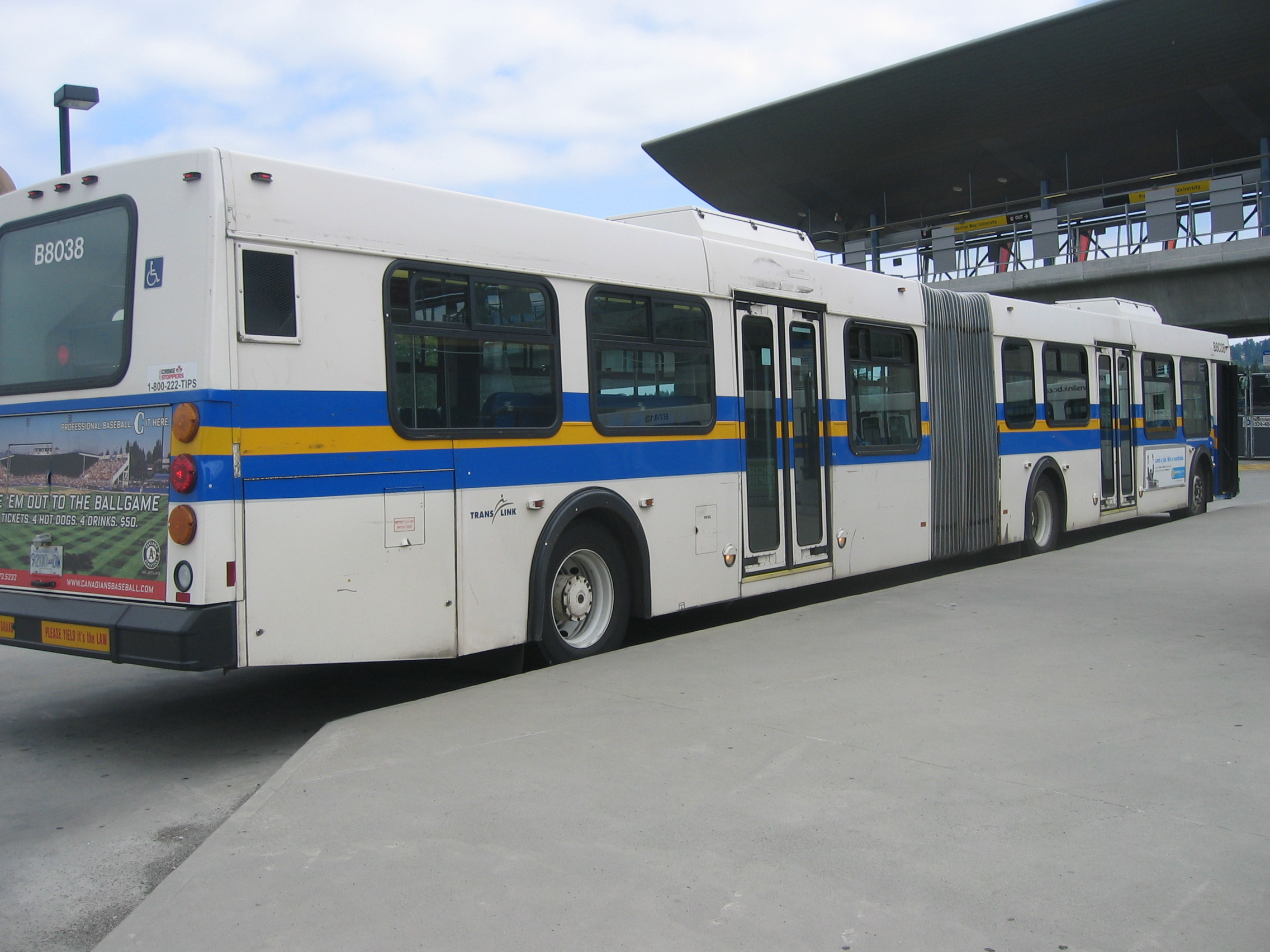
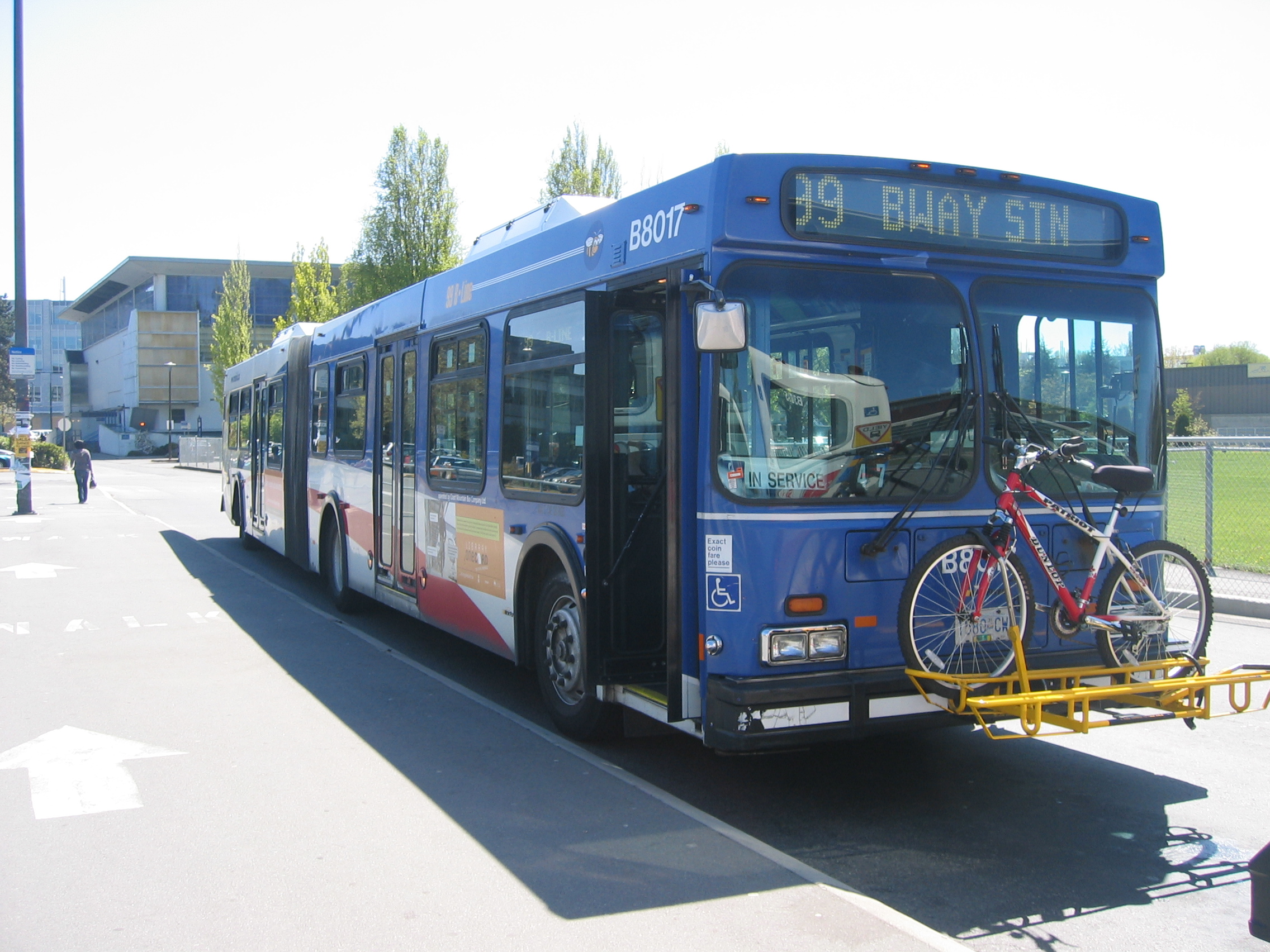 Above is a standard Coast Mountain Bus Company bus in Vancouver. Below it is a bus used on the 99 B-Line route. The special paint is a type of marketing, allowing people to identify the premium service at a glance.
The ultimate form of bus rapid transit uses premium transit buses with unique paint schemes in the same way VIVA does.
Fare CollectionIn order to reduce dwell times, bus rapid transit routes generally have proof-of-payment systems in place, letting passengers with valid tickets or passes board via all doors. On an articulated bus, this means loading time is up to three as fast. Some Van Hool double-artics can have five doors, further speeding up boarding times. For passengers who need to pay, ticket vending machines will be provided for them to buy tickets before hand. When a fare card system is in place, the reader will be either on board the vehicle or at the stop. VIVA's system is the ideal in this case.
Guide WayBus rapid transit can be considered rapid transit is because it operated independently of traffic. Normally this comes in the form of transit-only lanes on roads, only running in mixed traffic where absolutely necessary. A Spadina-style centre reservation is preferable, especially if local routes still use the road, but curb lanes can still work if the local police strictly enforce them. Usually, buses will get signal priority at intersections, allowing green lights to stay green longer if the bus is running behind. Another option is to construct a bus-only road running parallel to the travel corridor. Ottawa has done this in the outlying areas, with transit-only lanes in the downtown. In Adelaide, Australia, a unique guided bus way is in use, where buses drive onto a track and are taken at high speed into the suburbs.
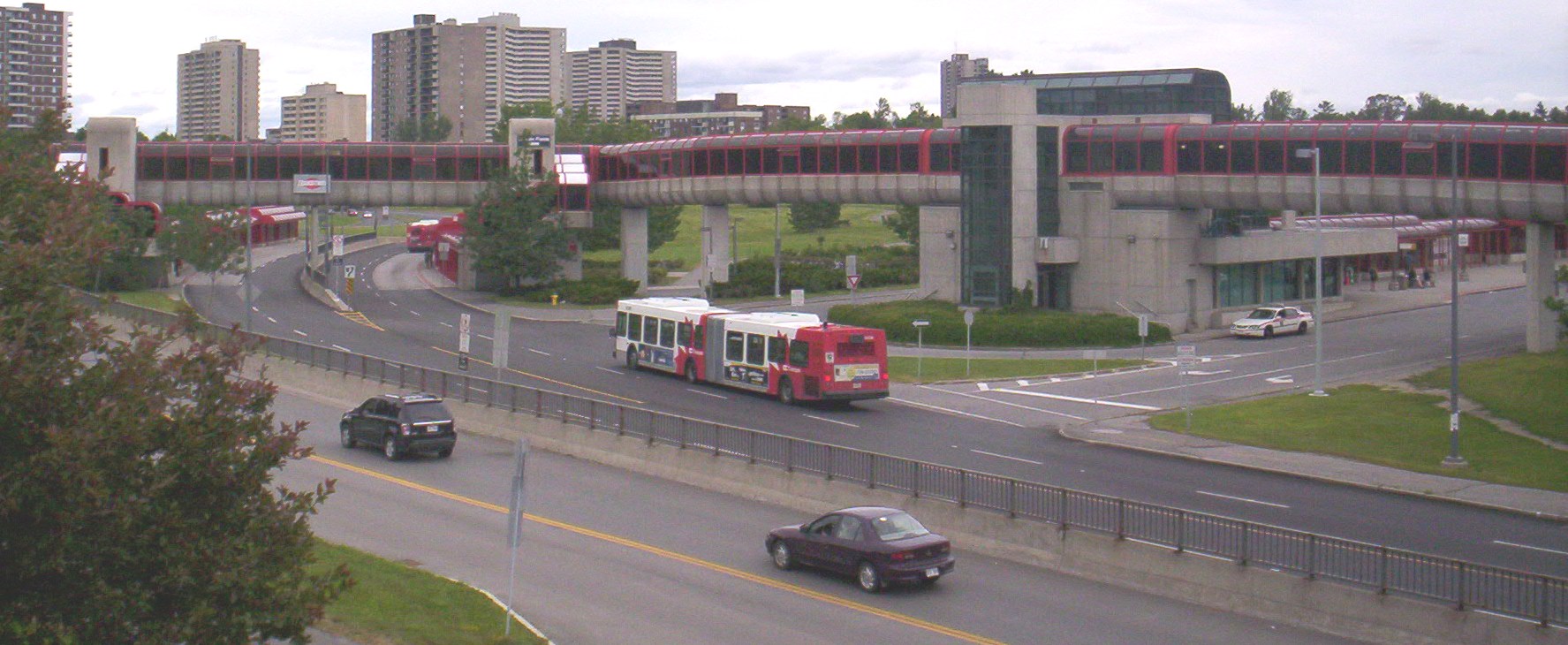
 Where there's is space, a transit only corridor can be used to provide rapid transit service between the suburbs and the city. In Ottawa (above), the Transitway parallels the major highways radiating from the city centre. In Adelaide, the O-Bahn (below) takes buses from the suburbs to the downtown with the efficiency of a railway.
For the inner city, phase two of VIVA is an example of bus rapid transit in its highest evolution. To connect the city to the suburbs, transitways are the way to go. In most cases, bus rapid transit guide ways are built to be rail-ready, in case capacity issues warrant upgrading to light rail.
StationsIn order to maintain the "rapid" part, bus rapid transit lines cannot stop at every stop along the route. Like VIVA, stops are only located at major intersections and major destinations. For transit-only lanes, a typical stop will consist of a roadside shelter, a ticket vending machine and a display indicating the arrival time of the next vehicle. Normally, a special sign will be used to distinguish bus rapid transit stops from local service stops. When a bus-only road is used, the stations can be much more intricate, with many more services available.
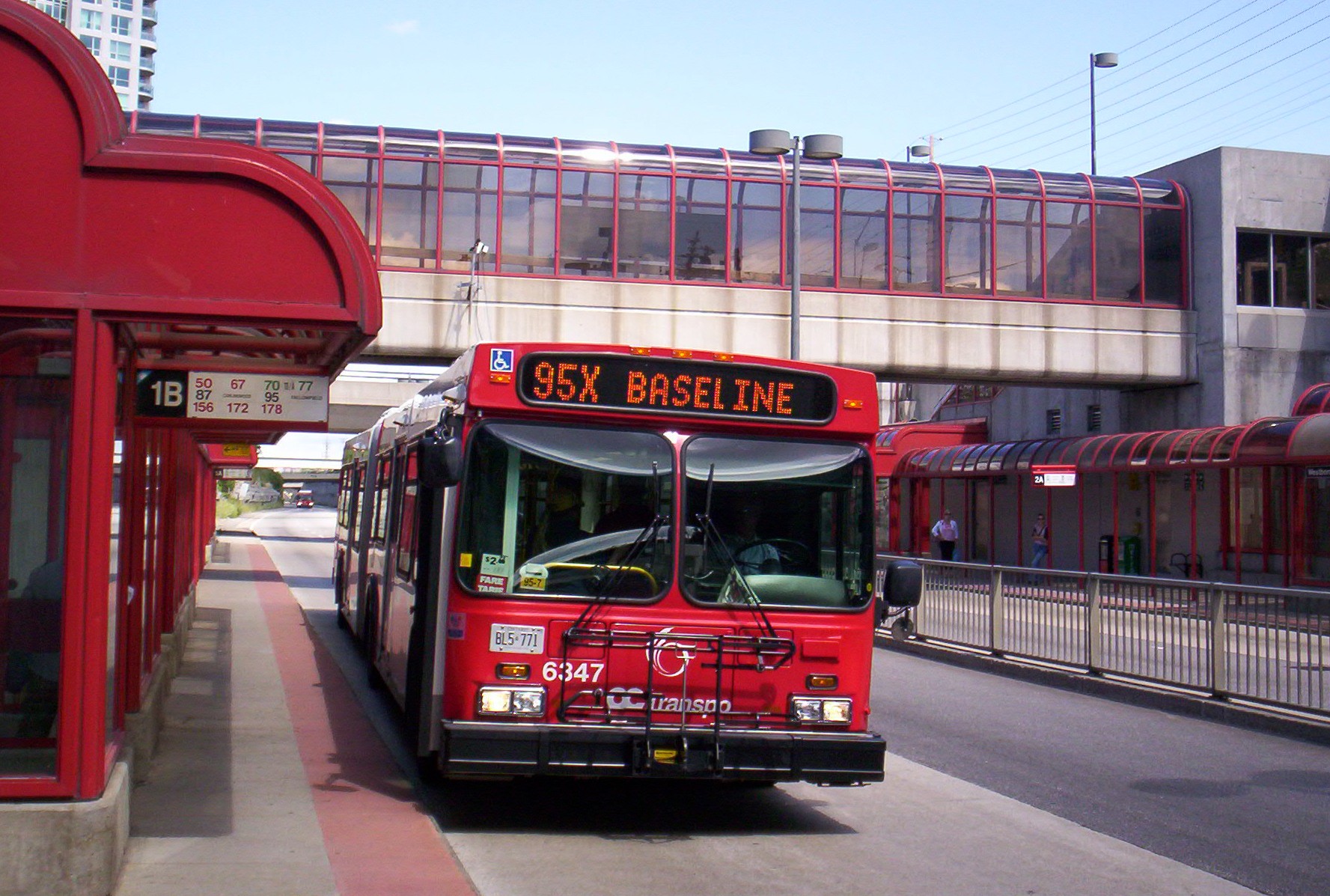 The station at Westboro on Ottawa's transitway has a platform for each direction with a walkway connecting the two sides. The facility is fully accessible, and serves 59 routes. Many stations on the outskirts of the city are build in a simillar style.
The station spacing used by VIVA is what bus rapid transit is designed to be. Local routes should still be operated to cover the gaps, but care must be taken to ensure they don't hold up the rapid transit services.
ConclusionsCare must be taken when talking about bus rapid transit services when compared to bus-only lanes. If buses stop at all stops along the route, it's not bus rapid transit in the truest sense of the word. Either way, this technology has a low setup cost, can deliver results immediately, and using a phased implementation, can be up and running in a few years. If we are truly too poor for subways, then bus rapid transit is an option that we should (are have) seriously consider.
I'll leave you with a series of videos about a bus rapid transit system being implemented in
Eindhoven in The Netherlands. Part 1, Part 2 and Part 3 are here. Could we see it in the GTA? I sure hope so.
Labels: bus rapid transit
VIVA: One Year Later
It was on this day (the day after labour day) when VIVA buses first hit the streets, and
an article in the Toronto Star was published yesterday to mark the occasion. When the final extension into Cornell in far east Markham is finished, expected by the end of the winter, the first phase will be complete. Even without the benefit of transit only lanes, VIVA has caused ridership in York Region to increase 38% in a single year. It's had it's share of problems initially, as the article notes, but overall, it has been a success and may very well start a new transit renaissance in Toronto.
Happy birthday, and viva VIVA!
Labels: bus rapid transit, york region transit


